A Museum Afternoon Built Around One Space Exploration Question
Plan a museum afternoon around one space exploration question, linking exhibits into a focused visit and leaving with a clearer answer and useful notes.
A focused museum afternoon starts with one space exploration question, not a race to every gallery. Choose a question that can connect an object, its setting and the choices behind a mission, then let the exhibits shape your route.
This approach suits a visit to a space museum, a science centre or a general museum with a flight, engineering or astronomy gallery. You can leave with a clearer answer and a few specific details to remember, while keeping time for a bench or an unexpected display.
Choose a question
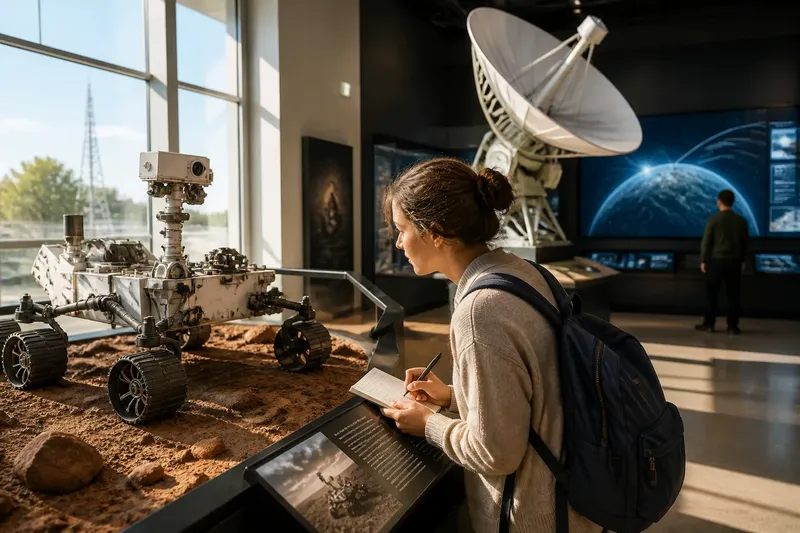
Pick a question that invites more than one kind of evidence. “How does a rover explore a place too dangerous for people?” could lead from wheels and cameras to communications and the work of interpreting images on Earth.
A broad question such as “How do we explore space?” is harder to use as a route. Narrow it to a decision or challenge: “What must a lander do before it can send a signal home?” Now you have something to look for in models, mission displays and control equipment.
Before travelling, check the museum’s current opening information, floor plan, access details and booking arrangements. Note a likely starting gallery, a nearby place to pause and one possible alternative in case the first display is crowded or closed.
Plan a light route
Read gallery descriptions rather than trying to learn the collection in advance. You are looking for possible links, not a script to follow. Save the map on your phone, or pick up a printed plan if you would rather not keep checking a screen.
Make three brief notes before you set off:
- Starting thought: Write one sentence answering your question now; if it is already specific, keep it as your baseline, but if it is vague, narrow it to one mission challenge.
- Useful evidence: Choose a feature to watch for, such as an antenna, sample container or control panel; if the gallery mentions that feature, look for it, but if it does not, follow a related object instead.
- Open doubt: Note what you are unsure about; if an exhibit addresses it, compare its label with your starting thought, but if it does not, keep the doubt for a later gallery or another source.
- Route option: Mark a second nearby gallery; if the first is accessible and relevant, continue there, but if it is busy or unrelated, use the alternative you marked.
- Pause point: Identify a bench, café or quiet area on the plan; if you feel your attention slipping, stop there, but if you are still engaged, carry on and pause when needed.
- Display status: Check whether a promising exhibit is temporary or has a booking note; if it is open to walk-in visitors, include it, but if access is limited, choose a related permanent display.
These are prompts, not homework. If you are visiting with someone else, agree that either person can suggest a detour when an exhibit clearly connects to the question.
Start with an object
On arrival, use the entrance map to reach the gallery most likely to give you context. Find one central object or display, read its label, then look closely at its form and layout. The label may explain its purpose; the object can help you notice what its designers had to accommodate.
Record one observation and one uncertainty in a notebook or phone note. For instance, a broad antenna might prompt the question of whether it needs to point towards Earth all the time or only during communication windows. Keep the observation separate from your guess.
Say you arrive at an invented museum with the question, “How can a rover explore a place too dangerous for people?” Your starting thought is that cameras help people inspect the terrain, and your planned stops are a rover model and a communications display. At the rover, you observe its wheels and camera mast and note that the label says it sends information back; at the communications exhibit, you learn from its display that signals need receiving and interpretation on Earth. Your revised answer is that remote exploration depends both on equipment at the destination and on people making sense of the information sent home. The trade-off is that you have followed one thread in depth rather than seeing every gallery.
Follow connected clues
Choose the next stop for the clue it might add, rather than simply moving to the next room. A spacecraft model may show what a mission carries; a mission-control display can suggest how people respond to incoming information; a destination map may explain what the mission is trying to understand.
Give each stop a purpose: does it explain the challenge, the engineering response or the result? If an exhibit does not connect, leave it for another visit rather than reading every label out of obligation.
Check what kind of object you are seeing. A flown instrument, a training model, a proposed design and a later reconstruction are different things. If the label does not make the distinction clear, note the uncertainty instead of treating the display as direct evidence of a completed mission.
Keep the pace comfortable
Pause before concentration runs out. Sit on a bench or find a café, then look at your notes: has an object changed your starting answer, strengthened it or left it unsettled? Any of those responses can help you decide what to see next.
For the rest of the visit, choose one direction: revisit an object that now seems important, look for a missing kind of evidence, or follow a companion’s related question. If a gallery is crowded, read the label from the side, return later or move to a connected display instead of waiting indefinitely for a clear view.
Questions for your visit?
How many exhibits should I plan to see?
Mark a few likely stops and leave room for a detour and a pause. Keep an exhibit on your route if it adds a different clue; if it repeats what you already understand, move on or save it for another visit.
What if there is no space gallery?
Look on the map for engineering, communications, navigation or Earth observation displays. If their labels connect to your question, use them as evidence; if the connection is unclear, record it as a possibility rather than assuming it.
Can children follow the same question?
Share the central question but let children choose details to watch for, such as wheels, food storage or signals. If a detail catches their interest, follow it to a related exhibit; if the wording proves too difficult, simplify the question together.
What if I cannot answer my question?
Write down what the displays helped you explain and what remains uncertain. If the question has become more precise, take that version to a museum educator or a library book; if it still feels too broad, narrow it before seeking more information.
Close the thread
Before leaving, reread your first note and write a short answer in plain language. Add the object that most influenced it and one question you would ask next. That gives your space exploration question a useful ending for the afternoon without pretending the exhibits settle every part of the subject.
Keep the answer with the museum map or a photo of your notes. When you plan another museum visit, that record can help you choose a fresh question and see how a different route changes what you notice.