The Constellation Picture Trap: Why Star Patterns Do Not Match Their Diagrams
Constellation diagrams are interpretations, not sky portraits. Learn to recognise star groupings by their relationships and find familiar patterns more calmly.
Constellation diagrams are interpretations, not literal pictures of the sky, so the familiar figure on a chart may be hard to spot overhead. If you search for the exact outline of a hunter, a swan or a pair of twins, you can miss the simpler arrangement of stars that the drawing was meant to suggest.
Stars without outlines
Look at a printed constellation and you will usually see dots joined by clean lines, perhaps with a name or an illustrated figure nearby. Those lines are added for the reader; the stars themselves do not trace them, and the human shape is an artist’s interpretation rather than something visible among the points of light.
The drawing makes an uneven field easy to remember. A diagram can choose which stars to connect, where to place the body or wings, and how much detail to leave out. Another chart may connect the same stars differently without changing the stars in the sky.
There is a second reason the picture can feel unconvincing: diagrams flatten the celestial sphere onto a page. A chart’s orientation, projection and level of detail affect how the pattern looks. Turn the page, use a chart for a different hemisphere, or view a phone display rotated away from the sky, and a familiar shape may seem to point the wrong way.
Relationships, not figures
Instead of hunting for a complete outline, notice how the brighter stars sit in relation to one another. Is there a short row, a crooked chain, a compact cluster, or a pair with a noticeably wider gap? These descriptions stay useful even when the imagined animal or character refuses to appear.
Start with a distinctive feature, then look around it. Orion, for example, is often introduced through the three stars in its belt: a conspicuous short line that gives you an anchor. From there, you can notice the brighter stars around it and gradually connect the pattern, without demanding that the whole constellation look like a person.
Relative brightness helps, too. A constellation is not a set of equally bright points, and the dimmer stars that complete an illustration may be difficult to see from a town, through haze or under a bright Moon. Try the pattern with its most noticeable stars first; treat the fainter points as additional detail, not a missing piece that means you have failed.
How do diagrams shape what you see?
Why do different charts draw different lines?
Constellation stick figures are teaching choices, not official lines painted across the sky. A chart may connect stars to make a particular figure easier to remember, while another prioritises a different grouping; compare the dots and their arrangement rather than expecting the artwork to match.
Why does a constellation look smaller overhead?
A diagram fills a page, while the sky surrounds you and offers no frame. Your eye has to pick a small region out of a much larger field, so begin with a landmark you can recognise and let the surrounding pattern emerge.
Can the same stars suggest another shape?
Yes. People can imagine different outlines among the same points, which is one reason constellation art varies. The useful thing to learn is the arrangement that helps you identify the region, not a single supposedly correct picture.
What if I cannot see the faint stars?
Use the brighter stars as a partial pattern and accept that the full diagram may not be visible from your location. Give your eyes time to adjust, avoid staring at a bright phone screen, and check a chart with its display dimmed or covered by a red-light mode.
A patient way to look
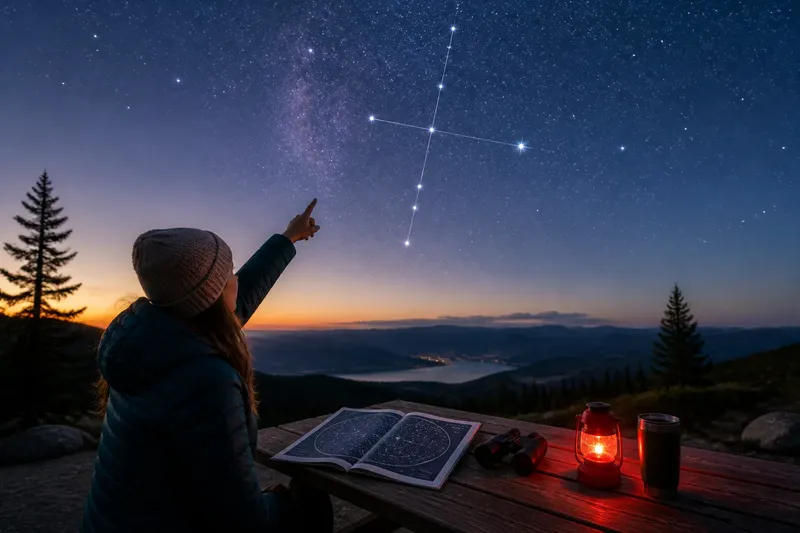
Say you are at a dark-sky picnic area with a printed chart showing a swan stretched across the page. Rather than searching for a bird’s head and wings, you first find the prominent cross-like arrangement of its brighter stars, then trace the longer line running through it; the expected result is a recognisable pattern, even if no swan appears in your imagination.
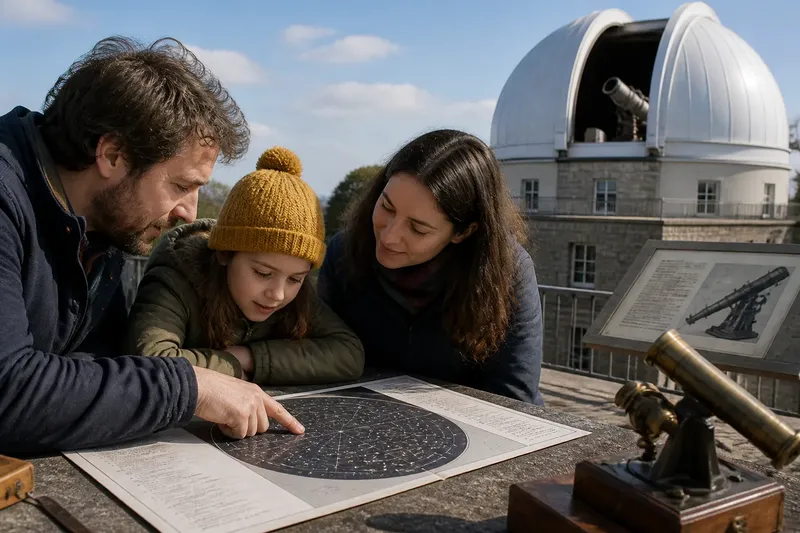
That approach works well with a paper planisphere, a printed star map or an app such as Stellarium. Match the chart to the date, time and direction you are facing, then check its orientation: some displays let you hold the phone up to the sky, while a page chart may need turning. Use the tool to confirm the star relationships, not to insist that the drawn figure is visible.
It also helps to pause before naming anything. Let your eyes settle on a small patch, notice the gaps and alignments, and then compare those observations with the chart. A friend may spot a different outline from yours; you can still agree on which stars make the recognisable row or corner.
Reading the sky on its terms
Constellations are useful regions and memory aids, but the stars within one are not necessarily close together in space. They appear near one another from our viewpoint; their apparent grouping is not a scale model of a connected object. For casual skywatching, you do not need to calculate their distances—just avoid treating the drawn figure as a physical shape.
There is pleasure in letting the diagram loosen its grip. Once you know a pattern by its bright points and their spacing, the sky can feel less like a picture quiz and more like a place you are learning to read. On your next clear evening, take one constellation and remember a single anchor—perhaps a short line or a crooked chain—before looking for any outline at all.
The constellation picture trap is easy to avoid: use the drawing as a prompt, then trust the stars’ actual relationships. That shift makes familiar patterns easier to find and leaves room for the sky to look like itself.